Syntax Cases and Precedence
This page explains compact forms, binding rules, and syntax limits that are easy to misread. Read it alongside the Language Specification, especially when generating TextGraph with an AI tool. Download the same source as Syntax Cases Markdown.
Groups take precedence over labels
Curly braces are reserved for group structure. A colon introduces text only until the next { or }. When a group body follows a named endpoint, the text before its opening brace is the group title. This rule also applies inside connections. Spaces around braces and arrows are optional.
| Source | Meaning |
|---|---|
X:{A->B} | Group X contains nodes A, B, and their connection. Its default title is X. |
X:Title{A->B} | The same group, with the title Title. |
A->C:{value} | Node A connects to group C, which contains node value. |
A->C:Services{value} | The target is group C, titled Services. |
A->C: contains | There is no group body, so contains is the edge label. |
X:{} | An empty named group, with default title X. |
| An anonymous group containing another anonymous group containing node value. |
X: | Named group X containing an anonymous group containing node value. |
These two forms have the same structure:
TextGraph source
X:Title{A->B}Rendered diagram
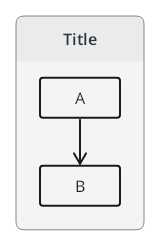
Preview unavailable in the current renderer. The source remains available to copy.
TextGraph source
X: Title {
  A -> B
}
Rendered diagram
Preview unavailable in the current renderer. The source remains available to copy.
The opening brace belongs to the header line; the body may continue on later lines. Moving body content onto a new line does not turn a group into a label. Multiple bare members need separate lines: { B C } is not a two-member group. Use { B -> C } for a connection, or put B and C on separate lines.
A group endpoint is one compound subject
TextGraph source
A->{B}->C:{value}Rendered diagram
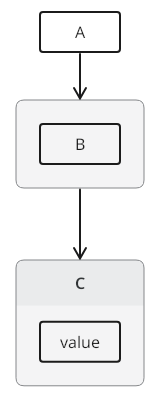
Preview unavailable in the current renderer. The source remains available to copy.
This creates node A, an anonymous group containing B, and named group C containing value. The two outer arrows connect A to the anonymous group boundary, then that boundary to C's boundary. There is no edge label and no ordinary node named C. The anonymous group occurrence is reused by both arrows.
Group titles and edge labels can coexist:
TextGraph source
A -> C: Services {value}: containsRendered diagram
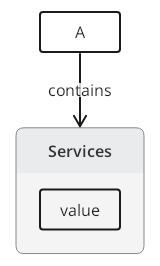
Preview unavailable in the current renderer. The source remains available to copy.
The first colon introduces group C's title, Services. After its closing brace, : contains labels the connection from A to C. Without a following body, a connection's trailing colon introduces an edge label. In A -> B -> C: data, it labels the last edge, B -> C. Write separate connections when each edge needs its own label.
Labels cannot contain literal curly braces
Neither {value} nor is a label template or a literal-brace escape. Quoting or prefixing a backslash does not turn curly braces into label text. Node labels, anonymous-node labels, group titles, and edge labels do not support literal curly braces. Use text such as value or Template value instead.
| Source | Result |
|---|---|
X: {value} | A group definition, not a node with a brace-containing label. |
A -> {B}: {value} | Invalid: a completed group endpoint cannot acquire another body through an edge label. |
A -> [{value}] | Invalid: an anonymous-node label cannot contain curly braces. |
X: label } | Invalid: the closing brace has no owning group. |
X:{A->B | Invalid: the group body is not closed; it does not fall back to label text. |
Parentheses bind at their position
| Source | Meaning |
|---|---|
A ->(bold) {B} | The edge is bold. |
A -> {B}(horizontal) | The target group uses horizontal layout. |
A -> C(horizontal): Services {value} | Named group C uses horizontal layout and the title Services. |
(horizontal){B}->A | Sets the containing scope's direction, then connects an anonymous group containing B to A. |
(horizontal) | Styles its containing scope: diagram direction at the root, group direction inside a body. |
To combine edge and group styles, put each class list at its owning position:
TextGraph source
A ->(bold) C(horizontal): Services {value}Rendered diagram
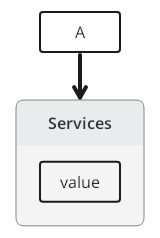
Preview unavailable in the current renderer. The source remains available to copy.
Standalone parentheses style the containing scope
An anonymous group's own styles belong inside its braces:
TextGraph source
{
  (horizontal)
  A -> B
}
Rendered diagram
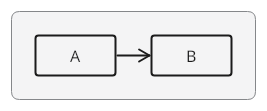
Preview unavailable in the current renderer. The source remains available to copy.
The rule applies to all style classes. A standalone (horizontal primary dashed) inside a group sets that group's layout and appearance. Body classes merge with header classes and may appear before or after members. They do not decorate member nodes or other groups. Conflicting directions produce a diagnostic rather than silently overriding each other.
The following compact and multiline forms have the same meaning:
TextGraph source
(horizontal){A->B}Rendered diagram
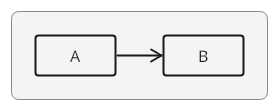
Preview unavailable in the current renderer. The source remains available to copy.
TextGraph source
(horizontal)
{A->B}
Rendered diagram
Preview unavailable in the current renderer. The source remains available to copy.
Both contain two statements: set the document's direction, then define an anonymous group. The preceding class list does not attach to that group, and inserting whitespace or a newline does not change ownership. To set the group's direction, use the body form above. A named group can still attach styles to its name: G(horizontal){A->B}.
A label on a targetless style statement also stays with that statement. (horizontal): Services {A->B} does not title the anonymous group; use G(horizontal): Services {A->B} when the group needs a title.
TextGraph source
(vertical)
Outer {
  (horizontal primary)
  A -> B
  Inner {
    (vertical dashed)
    C -> D
  }
}
Rendered diagram
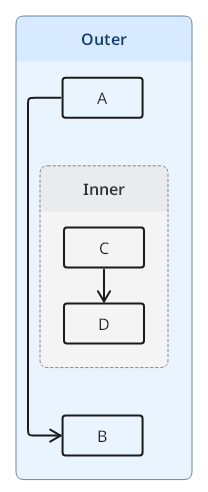
Preview unavailable in the current renderer. The source remains available to copy.
The document has vertical direction, Outer arranges its direct contents horizontally, and Inner arranges its contents vertically. Each standalone class list belongs only to its immediate scope. Writing (horizontal){C->D} inside Outer sets Outer's direction and defines an unstyled nested group; it does not set the nested group's direction.
A repeated label does not create a reusable anonymous identity
Each separate [B] occurrence creates a new anonymous node. In A -> [B] -> C, one occurrence is shared by the two adjacent edges. The same occurrence rule applies to anonymous groups. Use a named node or group when another statement must refer to it.
Group structure and decorations have different roles
Group bodies contain connections, bare member names, nested groups, standalone scope styles, and comments. Inline endpoint styles and edge labels are allowed. Put standalone member labels and targeted styles at the document root:
TextGraph source
Backend {
  api -> saved
}
api: Service API
saved(fill success): Saved result
Rendered diagram
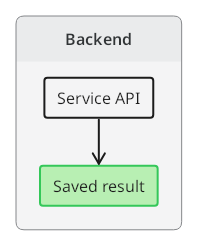
Preview unavailable in the current renderer. The source remains available to copy.
Writing api: Service API as a standalone statement inside Backend is invalid. A header such as Services: Backend {api} is a nested group definition and is valid there.
Short names depend on scope
Inside a group, a short node name creates or reuses a local member. At the root, a unique short name refers to the existing subject anywhere in the diagram. If several groups contain that name, qualify it:
TextGraph source
First { A -> B }
Second { A -> C }
First.A -> Second.A
Rendered diagram
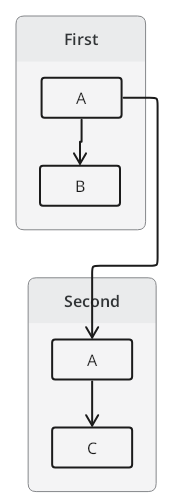
Preview unavailable in the current renderer. The source remains available to copy.
Here the two A nodes are distinct. Root A -> B would be ambiguous. A qualified reference such as First.A selects an existing subject and never creates missing groups or members. Labels and root references may precede or follow the groups without changing membership.