Docker renderer
Run TextGraph on your own infrastructure. The published container accepts TextGraph over HTTP and returns PNG or SVG, using the same rendering engine as the SDK. No browser or .NET host installation is required. The published image targets Linux amd64.
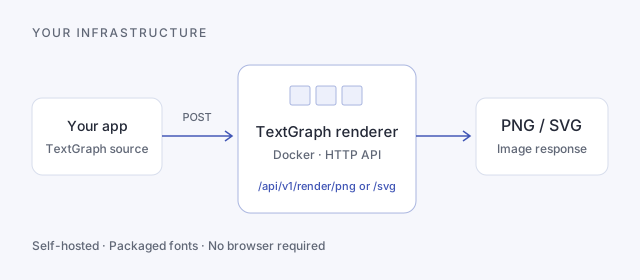
Start the container
docker run --rm --read-only --cap-drop=ALL --security-opt=no-new-privileges \
  -p 127.0.0.1:8080:8080 ghcr.io/drawmotive/textgraph-renderer:0.3.0
This binds the service to localhost. The image includes the exact public SDK, packaged fonts and their notices. The default container has one rendering Worker; scale Workers or containers according to available memory.
Render a diagram
curl --fail-with-body http://localhost:8080/api/v1/render/png \
  -H 'Content-Type: application/json' \
  -d '{"source":"web -> api -> database"}' -o diagram.png

curl --fail-with-body http://localhost:8080/api/v1/render/svg \
  -H 'Content-Type: application/json' \
  -d '{"source":"web -> api -> database"}' -o diagram.svg
Both endpoints accept source, optional padding, and optional language, such as zh-CN or ja. PNG also accepts scale and maxWidth. Successful responses contain image bytes; invalid diagram source returns HTTP 422 with compiler diagnostics. GET /health reports Worker availability. Busy capacity returns HTTP 429 with Retry-After.
Sources and rendered images are neither persisted nor logged by the renderer. The API is anonymous; your deployment owns access control. The public renderer-test.textgraph.dev endpoint is a temporary image-verification environment, not a production service.
Choose your integration
- Full API, configuration and container instructions
- Published Docker images
- JavaScript SDK for rendering inside your browser, Worker or Node.js application.
- DrawMotive editor for a visual canvas and editable documents.
Service code and public SDK code are MIT licensed, including commercial use and redistribution. Preserve their copyright and license notices, together with the accompanying font and dependency licenses.